 Baldur's Gate 3
Baldur's Gate 3 build warlock: Best BG3 Warlock Build Guide

Quick Answer: The best baldurs gate 3 build warlock is usually a high-Charisma Eldritch Blast caster who controls fights, breaks concentration, and scales cleanly from early game utility into reliable late-game ranged damage.
Build Identity
This Baldur's Gate 3 warlock build is a ranged controller and sustained damage dealer that wins by turning short-rest resources into repeatable pressure. The class fantasy is simple: stay safe, force enemies to spend actions badly, and make every round matter with Eldritch Blast, Hex, and invocation support. In practice, that means you are not playing a burst wizard or a pure weapon striker. You are a pact-powered caster who can solve encounters through positioning, push effects, conversation power, and a small but efficient package of spells.
Warlock is especially attractive in BG3 because the class asks very little from its gear to function. That matters in a party-based RPG where strong items are often contested. You can be effective with minimal investment, then scale hard once you start stacking Charisma, spell attack bonuses, and invocation synergies. The class also fits the game’s cadence well: Baldur’s Gate 3 is a story-rich, party-based RPG set in the universe of Dungeons & Dragons, and it can be played alone or in a group, so a self-sufficient caster with dialogue strength and combat utility slots into many party structures naturally Source Source.
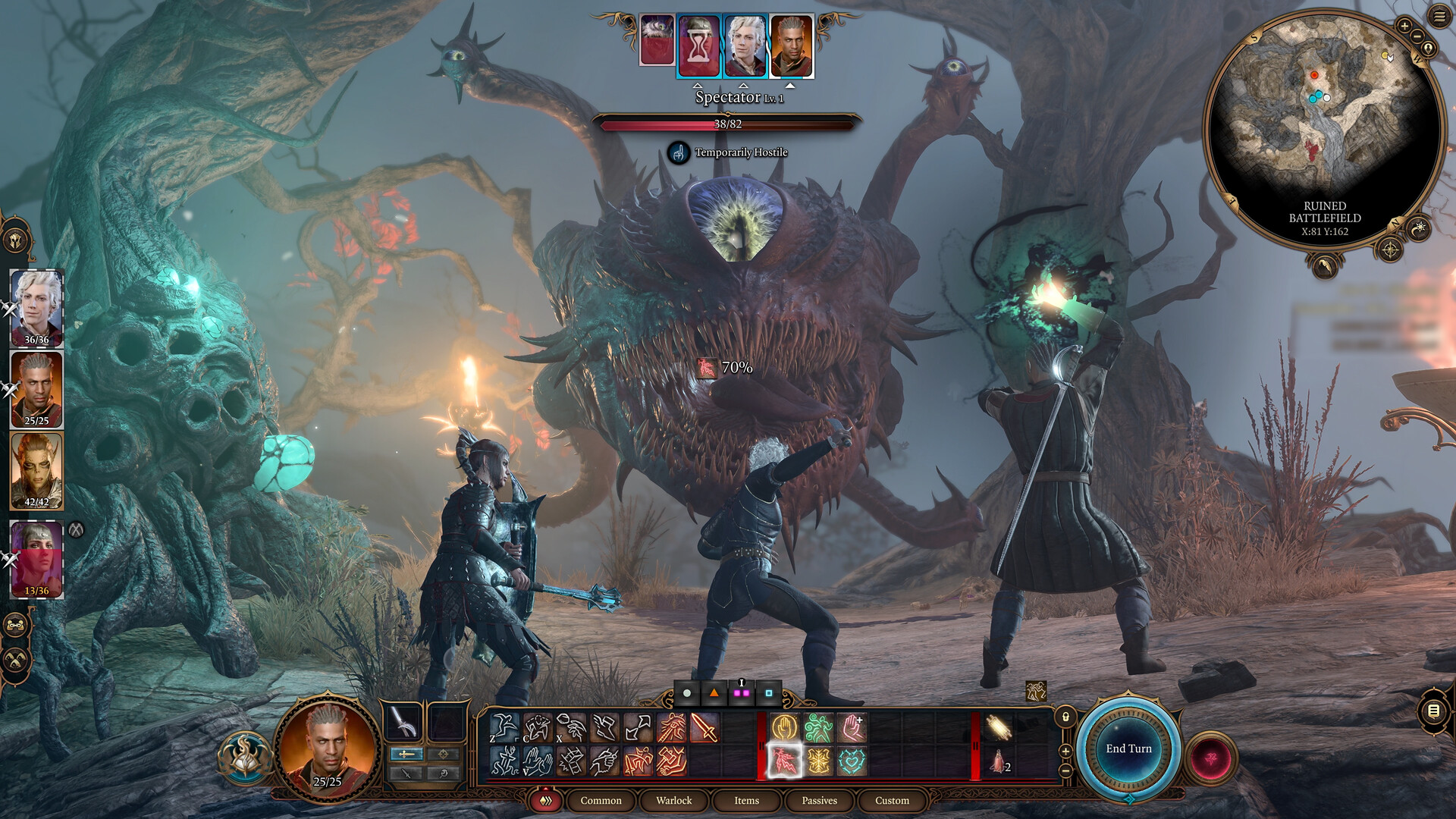
A warlock build is not just “press Eldritch Blast every turn,” although that is part of the shell. The better version of the build layers in control and tactical denial. Examples include using Hex before a long fight, choosing Repelling Blast to push enemies off ledges in places like the Goblin Camp or Moonrise Towers, and leaning on Hunger of Hadar to corral enemies in chokepoints such as the Zhentarim Hideout or the narrow approaches in the Shadow-Cursed Lands. Those examples matter because warlock power in BG3 is amplified by terrain, line of sight, and enemy pathing, not just raw damage numbers.
There are also multiple ways to define the build identity. A Great Old One warlock pushes more into fear and control. A Fiend warlock feels sturdier and more forgiving because it supports survivability and momentum. A Pact of the Blade variant shifts toward melee or hybrid play, often with multiclass support, while a Pact of the Chain version leans into scouting and utility. For most players searching for a baldurs gate 3 build warlock, the safest recommendation is a Charisma-first blaster-controller that uses spells for setup and Eldritch Blast for consistent turns.
| Warlock Style | Role | Best For | Main Tradeoff |
|---|---|---|---|
| Eldritch Blast Controller | Ranged damage and push control | New players, solo play, flexible parties | Lower peak burst than some multiclasses |
| Fiend Durability Build | Damage with extra safety | Hard fights, messy encounters, beginner comfort | Less control than Great Old One |
| Great Old One Control Build | Fear and disruption | Players who like battlefield denial | More dependent on enemy susceptibility |
| Pact of the Blade Hybrid | Melee or hybrid striker | Players who want weapon play | More gear and stat pressure |
Stat Priorities
The stat order for a Baldur's Gate 3 warlock build is Charisma first, Constitution second, then Dexterity, with other scores filled in according to your race choice, companions, and playstyle. Charisma is your core because it improves spell attacks, conversation checks, and the reliability of the entire build. Constitution comes next because concentration checks matter constantly once you start maintaining spells like Hex, Hunger of Hadar, or Hold Person. Dexterity is your third priority because initiative and armor class are both valuable for a ranged caster who wants to act before enemies close the gap.
A practical priority list looks like this:
- Charisma - This is your main scaling stat and the one that defines whether your offensive spells connect reliably in fights against enemies like goblins, cultists, and later armored humanoids in Act 2 and Act 3.
- Constitution - This keeps concentration intact when you are hit by archers, mages, or melee divers, which is common in battles such as the Goblin Camp raid, the Moonrise Towers assault, and the Orin fight.
- Dexterity - This supports initiative and survivability, especially before you have access to stronger defensive gear.
- Wisdom - This is useful for saving throws, but it is usually secondary unless your race or item choices leave you room to invest.
- Strength - This is generally low value unless you are specifically building around melee weapons and Pact of the Blade interactions.
- Intelligence - Usually the weakest stat for this build unless a very specific item or multiclass plan requires it.
The key reason for this ordering is that warlock is fundamentally about efficient resource conversion. You have limited spell slots, but your cantrips and invocations do the daily work. That means the build rewards high spell reliability more than a broad spread of average stats. In the current meta, most players get more value from raising Charisma aggressively than from trying to be “well-rounded.” A 16 or 17 starting Charisma, followed by a clean improvement path, usually feels much better than splitting points across several attributes.
Different variants shift the emphasis slightly. A Pact of the Blade setup may want more Dexterity or Strength depending on weapon choice and armor goals. A pure caster wants Constitution and Charisma as the core, with Dexterity as a comfort layer. If you are leaning into conversation and quest outcomes, Charisma also pulls double duty outside combat, which is especially valuable in a game built around choice-driven story progression and party interactions Source.
In practice, the stat priority should be judged by what actually kills warlocks in BG3: failed concentration, acting too late in the round, or missing high-value attacks when you need them most. Strength does not help with that. Charisma does.

You might also like
- Baldur's Gate 3 Solve the Open Hand Temple Murders: Beginner Guide
- baldurs gate 3 best lae'zel build
- Baldur's Gate 3 baldurs gate 3 build tool: A Practical Build Guide for Reliable Party Power
- Baldur's Gate 3 baldurs gate 3 best wizard build
- Baldur's Gate 3 Kill Raphael's Old Enemy Beginner Guide
Best Skills and Combat Priority
The best combat priority for a warlock build is to open with control or setup, then spend the rest of the fight converting Eldritch Blast and short-rest resources into pressure. Warlock turns are usually simple in execution but flexible in choice, and that flexibility is what keeps the class strong across the whole campaign. You are not trying to memorize a long rotation. You are choosing the right opener and then repeating the most efficient option until the fight ends.
A practical combat priority looks like this:
Open with a control spell when the battlefield is crowded
Examples: Hunger of Hadar against clustered enemies, Hold Person against humanoid targets, or Hex when you need a low-cost damage boost on a target that will stay alive for multiple rounds.Use Eldritch Blast as your default action
This is your bread-and-butter attack from early game onward, and it remains strong because it scales with levels and invocation support. It is especially good on ledges, bridges, stairways, and uneven terrain.Prioritize targets that can be pushed, frightened, or isolated
Examples: enemies near cliffs in the Underdark, attackers on walkways in the Grymforge, or casters standing behind the main line in fights at Moonrise Towers.Recast Hex or another concentration spell only when the current target is nearly finished
Do not waste concentration just to chase minor damage. The better play is to keep your control spell alive if it is shaping the fight.Use short-rest recovery aggressively
Warlock power is partly defined by how well you spend slots across multiple encounters. If you rest too late, you can underuse your best tools.Bring utility spells for terrain or defense when the encounter demands it
Examples: Misty Step for repositioning, Darkness when you can fight through vision denial, or Counterspell when an enemy mage can swing the fight.
The skill progression inside the build also matters. Early levels feel best when you focus on accuracy and range rather than trying to imitate a full wizard or sorcerer. You generally want one dependable offensive cantrip, one reliable concentration spell, one defensive repositioning tool, and one situational answer. That package is enough to clear most of the game’s early and mid-game content, including fights against True Soul enemies, gnolls, and later high-value Act 2 targets.
If you are running a control-heavy version, the practical priority is even more specific: identify what part of the enemy formation must be broken, then force movement or denial there. For instance, Repelling Blast is excellent when a bridge is available, Hunger of Hadar is strongest when enemies must move through it, and Darkness becomes much better if your team can operate inside or around it. A warlock that understands battlefield geometry is much more dangerous than one that only understands damage.
Gear and Loadout
The best warlock gear is the gear that increases spell reliability, reward on-hit effects, and concentration stability without demanding a complicated setup. Warlock is famously functional on modest equipment, but the build scales sharply when you combine item synergies with the class’s repeated cantrip pressure. You do not need the most ornate loadout available to start contributing, but by midgame and endgame you should be aiming for pieces that improve your spell attack rolls, grant extra casting value, or reward a ranged playstyle.
| Slot | Item | Reason |
|---|---|---|
| Weapon | The Spellsparkler | Excellent early-game caster weapon if available, because it supports repeated spell-driven pressure and rewards multi-hit casting patterns. |
| Weapon | Infernal Rapier | Strong option for Pact of the Blade or hybrid setups because it supports a Charisma-based weapon plan. |
| Head | Birthright | High-end Charisma-focused helm for builds that want to push conversation and spell performance together. |
| Cloak | Cloak of Protection | A simple but effective defensive layer that improves survivability and concentration stability. |
| Armor | Potent Robe | One of the most important caster robes for damage-focused warlock play, especially if you are leaning on cantrips. |
| Gloves | Spellmight Gloves | A strong damage option for players who can manage the accuracy tradeoff and want more punch on spell attacks. |
| Boots | Boots of Speed | Helps with positioning, retreating, and keeping line of sight in fights where enemies try to collapse onto you. |
| Amulet | Amulet of Greater Health | A premier defensive pickup for concentration-heavy play if you can access it. |
| Ring 1 | The Sparkle Hands | Useful in an early or midgame setup when you want to strengthen repeated attack patterns and lightning-oriented synergies. |
| Ring 2 | Killer's Sweetheart | Offers high-value burst interactions for specific kill windows and boss cleanup. |
This table is intentionally split between early, mid, and endgame style suggestions because warlock gear does not progress in a single linear line. Some items are excellent if you find them early, while others are best-in-slot only in a later chapter. The important thing is to understand the loadout logic: you want items that either improve your core action, increase concentration durability, or make your positioning more controllable.
There are also several real in-game examples that show why the loadout matters. In Act 1, a warlock with a simple damage-boosting setup can feel excellent in the Goblin Camp, the Whispering Depths, or around the Mountain Pass because the class can punish enemies from safety. In Act 2, concentration support becomes much more important in the Shadow-Cursed Lands and at Moonrise Towers, where getting interrupted can ruin your setup. In Act 3, high-stat items and defensive tools matter more in fights against elite bosses and dense enemy groups, where a single failed save or lost action can snowball.
For a budget warlock, your loadout should prioritize whatever gives Charisma, spell DC, concentration protection, or easier positioning. For an endgame warlock, the priority becomes stacking item synergies around your chosen specialization. A Great Old One control build wants different support than a Fiend blaster or a Pact of the Blade duelist. The best gear is not the rarest gear in a vacuum; it is the gear that reinforces the exact thing your version of the class is already doing well.
Counters and Hard Matchups
The hardest matchups for a warlock build are enemies that deny line of sight, resist your key control effects, or punish concentration before you can establish pressure. Warlock is strong, but it is not invulnerable. The class can lose a lot of value when fights become cramped, when you cannot move safely, or when your best spells are reduced to ordinary damage because the target is resistant to your preferred plan.
The most common counters are:
High mobility enemies
- Why they hurt: they can bypass your zone control and force you into defensive repositioning.
- Examples: fast melee divers, teleporting threats, and enemies that can reach the backline from awkward angles.
- Adaptation: use terrain, elevation, and push effects earlier, not later.
Concentration breakers
- Why they hurt: warlock often depends on keeping one strong effect active.
- Examples: archers, enemy mages, and any fight with repeated chip damage.
- Adaptation: protect yourself with cover, initiative, and defensive gear before casting your best control spell.
Vision-denial conflict
- Why it hurts: some enemies and some party setups do poorly when visibility is reduced, while others exploit it.
- Examples: fights where Darkness interferes with your own melee allies or where you cannot safely see targets.
- Adaptation: only commit to darkness-style play if your whole plan supports it.
Enemies that resist your preferred control
- Why they hurt: spells like Hold Person or fear-based pressure can lose value against the wrong target type.
- Examples: many humanoid-only effects become awkward when the battlefield includes beasts, constructs, or other resistant enemies.
- Adaptation: keep a second plan ready, usually Eldritch Blast plus a general-purpose damage or mobility spell.
Swarm fights in tight spaces
- Why they hurt: warlock excels at surgical pressure, but being surrounded reduces your freedom.
- Examples: cramped interiors, stairwells, and corridor fights.
- Adaptation: pre-position before combat, use chokepoints intentionally, and do not wait until you are pinned.
A few specific encounters illustrate the problem well. In the Goblin Camp, overcommitting to one target can be punished if you lose high ground or get swarmed. In the Gauntlet of Shar, vision and mobility management become much more important than raw damage. In Act 3 boss encounters, your concentration can get shredded if you ignore enemy pressure sources and focus only on offense. The answer is not to abandon the build, but to treat warlock like a control weapon rather than a turret.
The easiest adaptation is to stay flexible with spell selection. If a fight makes Hex inefficient, use a more disruptive concentration spell. If a boss ignores your control, fall back on repeatable Eldritch Blast damage and positioning. If your party already has strong control elsewhere, let the warlock become a pure pressure piece and save spell slots for the exact moments that matter.
Budget vs Endgame Variant
The budget version of this warlock build uses low-commitment gear, simple spell choices, and a straightforward Eldritch Blast game plan, while the endgame version layers in stronger item synergies and more specialized casting. The class is one of the easiest in Baldur’s Gate 3 to run cheaply because so much of its value comes from innate spell progression and invocations rather than elaborate equipment dependencies.
| Variant | Core Idea | Best Use Case | Main Advantage | Main Limitation |
|---|---|---|---|---|
| Budget Starter | Charisma-first blaster with basic utility spells | Early Act 1, fresh playthroughs, party gaps | Works with minimal gear investment | Lower ceiling against late-game threats |
| Midgame Transition | Control plus cantrip pressure with better defensive items | Acts 1-2 | Balanced offense and survivability | Still not fully specialized |
| Endgame Specialist | High-synergy caster or Pact of the Blade hybrid | Late Act 2, Act 3, optimized parties | Much stronger burst or control | More gear-dependent and less forgiving |
For a budget starter, the best substitutes are the items and spells you can get early without chasing a perfect route. A basic Charisma setup, Hex, Armor of Agathys if your build supports it, Misty Step, and a reliable invocation package already carry a lot of weight. If you do not have premium gear like Potent Robe or Birthright, that is fine. Use any robe, amulet, or ring that improves survivability, spellcasting comfort, or initiative. The goal is not to mimic the final build immediately. The goal is to keep your turns clean and your concentration intact.
For the endgame variant, the build becomes more precise. A controller leans harder into movement denial and save pressure. A pure caster starts caring more about attack bonuses, save DC, and concentration insurance. A Pact of the Blade version may build around Charisma-scaling weapon play and then use warlock spells as support rather than the centerpiece. That endgame route is often more demanding because it asks you to know which fights reward melee commitment and which ones punish it. In fights like those around Wyrm's Rock, the Netherbrain, or high-threat Act 3 encounters, that distinction becomes critical.
The best practical advice is to start budget and specialize later. Warlock is forgiving enough to do that cleanly. Your early game can be nothing more than good Charisma, smart positioning, and strong use of Eldritch Blast. Once the right items show up, you can branch into a more aggressive caster, a stronger control build, or a hybrid weapon setup without rebuilding the entire character.
Common Mistakes
Warlock players often make the same mistakes because the class looks simpler than it really is. The build is straightforward on the surface, but the difference between average and strong performance usually comes down to how well you manage concentration, positioning, and target selection.
Spending slots too early
- Why players do it: the class feels limited, so they panic-cast in the first turn.
- Fix: open with the most important control only when it changes enemy movement or action economy, not just to feel active.
Ignoring concentration protection
- Why players do it: early fights are easy enough that concentration loss feels like a minor issue.
- Fix: value Constitution, defensive gear, and cover before you try to maintain long fights with Hex or Hunger of Hadar.
Treating Eldritch Blast as mindless damage
- Why players do it: the cantrip is the default action, so they stop thinking about placement.
- Fix: use ledges, stairs, doorways, and push angles deliberately in places like the Underdark, Grymforge, and Moonrise Towers.
Building too much into mixed stats
- Why players do it: they want a character who can do everything.
- Fix: keep Charisma first and let the rest support your actual combat plan; warlock is strongest when focused.
Forcing concentration spells on bad targets
- Why players do it: they see a spell and want to get value from it every fight.
- Fix: save humanoid-only or fear-centric tools for the encounters where they matter, and fall back to generic pressure when they do not.
Standing in the open without a route out
- Why players do it: ranged characters feel safe until a jump, dash, or teleport closes the gap.
- Fix: move after attacking when possible, and keep a retreat line available before combat starts.
Overcommitting to one build branch too early
- Why players do it: Pact of the Blade, control warlock, and blaster warlock all look attractive.
- Fix: commit after you see which items and encounters are shaping your run, especially if you are still in Act 1.
These mistakes show up repeatedly in real play because Baldur’s Gate 3 rewards encounter knowledge, not just class familiarity. A warlock who understands when to slow the fight down will outperform a warlock who simply follows a fixed script.
Pro Tips
A strong warlock playthrough depends on a few habits that are easy to overlook. These are the kinds of decisions that start to matter once you know the class well enough to stop thinking about the basics.
Tip 1. Use terrain before damage
If a fight has a cliff, stairwell, or narrow bridge, solve that geometry first and the damage often follows automatically. Repelling Blast and Hunger of Hadar are much stronger when enemies have to move through bad ground in places like the Goblin Camp or the Grymforge.
Tip 2. Save control for turns that change enemy behavior
A control spell is worth more when it prevents multiple enemies from acting, not when it merely adds a minor inconvenience. Use Hold Person, Fear, or Hunger of Hadar when it changes pathing, not when the enemy is already effectively neutralized.
Tip 3. Keep one answer for awkward fights
Some encounters will punish your preferred plan. Keep a backup spell or action pattern for enemies that resist fear, ignore pushes, or force close quarters. A warlock with a fallback line is much more stable than one that depends on a single opener.
Tip 4. Use short rests like part of the kit
Warlock power is built around recharge rhythm. If you finish an encounter with slots left unused because you were saving them for later, you are often losing value across the adventuring day. Rest timing is part of the build, not just travel management.
Tip 5. Treat dialogue as part of your build
High Charisma changes outcomes outside combat as well as inside it. That matters in a game where choices shape the story and where many encounters can be influenced before initiative even starts Source. A warlock who wins conversations is often stronger overall than one who only wins fights.
Tip 6. Reposition before the enemy turn, not after the hit
If you know a melee threat can reach you, move preemptively. Warlocks often die not because they are fragile in theory, but because they stay still one turn too long while relying on concentration to carry the fight.
FAQ
Is warlock good for beginners in BG3?
Yes. Warlock is one of the most forgiving caster classes because Eldritch Blast gives you a reliable default action, and the build does not require perfect gear to function.
Should I use Fiend, Great Old One, or Archfey?
Fiend is the safest all-around option, Great Old One is better for control-flavored play, and Archfey is more specialized. The best choice depends on whether you want durability, disruption, or a more thematic caster.
Is Pact of the Blade better than Eldritch Blast?
Not automatically. Pact of the Blade is strong if you want melee or hybrid play, but a pure Eldritch Blast warlock is easier to pilot and usually more stable across the whole campaign.
What ability scores matter most for warlock?
Charisma matters most, Constitution is the next priority, and Dexterity usually follows after that. Those three do the most work for damage, concentration, and safety.
Do I need multiclassing for a strong warlock build?
No. A pure warlock can be very effective. Multiclassing can improve specific variants, but it is not required for a strong baldurs gate 3 build warlock.
Related Guides
- Baldur's Gate 3 Sorcerer Build Guide
- Baldur's Gate 3 Bard Build Guide
- Baldur's Gate 3 Fighter Build Guide
- Baldur's Gate 3 Best Early Game Builds
- Baldur's Gate 3 Multiclass Guide
- Baldur's Gate 3 Best Party Compositions
- Baldur's Gate 3 Best Gear by Act
Sources
- https://store.steampowered.com/app/1086940/
- https://en.wikipedia.org/wiki/Baldur's_Gate_3
- https://howlongtobeat.com/?q=bg3
- https://store.steampowered.com/app/1086940/
- https://steamcommunity.com/stats/1086940/achievements
See also
- Baldur's Gate 3 baldurs gate 3 best rogue build
- Baldur’s Gate 3 baldurs gate 3 build randomizer Build Guide
- Baldur's Gate 3 best wyll build
- Baldur's Gate 3 baldurs gate 3 best warlock build
- Baldur's Gate 3 baldurs gate 3 build manager Build Guide
- Baldur's Gate 3 best multiclass builds
- Baldur’s Gate 3 baldurs gate 3 build creator: The Best All-Round Build Guide for Story, Combat, and Honor Runs
- Baldur’s Gate 3 baldurs gate 3 build honor: Best Honor Mode Build Guide
- Baldur's Gate 3 best ranger build
- Baldur's Gate 3 Investigate the Sel nite Resistance Beginner Guide
Screenshots


Reviewed by
BG3 Hub Editorial
Expertise: Editorial team behind BG3 Hub. Content is compiled from official patch notes, community wikis, and playthrough notes, then reviewed and updated on schedule.
Sources
Baldur's Gate 3 Classes Guides →
Browse the complete classes collection and its focused guides.
Related Guides

🔥 Popular Guides
bg3 best builds for honor mode: Baldur’s Gate 3 Build Guide
Top BG3 Honor Mode builds, stat priorities, gear, counters, and budget options for a safer Baldur’s Gate 3 run.
baldurs gate 3 wizard builds: Best Wizard Build Guide
Best baldurs gate 3 wizard builds for control, damage, and defense, with stats, gear, rotation, counters, budget swaps, and tips.
baldurs gate 3 volk tier list: Best Builds Ranked for BG3
S, A, and B tier Baldur’s Gate 3 builds ranked with matchup notes, common mistakes, and Honour mode tips.
Baldur's Gate 3 Class Tier List
S, A, and B class rankings for BG3 with methodology, situational flips, patch notes, mistakes, pro tips, and FAQs.
📋 Patch Notes & Updates
🛠️ Popular Tools
Frequently Asked Questions
Quick answers from the guide · click a question to expand.
Is warlock good for beginners in BG3?
Yes. Warlock is one of the most forgiving caster classes because Eldritch Blast gives you a reliable default action, and the build does not require perfect gear to function.
Should I use Fiend, Great Old One, or Archfey?
Fiend is the safest all-around option, Great Old One is better for control-flavored play, and Archfey is more specialized. The best choice depends on whether you want durability, disruption, or a more thematic caster.
Is Pact of the Blade better than Eldritch Blast?
Not automatically. Pact of the Blade is strong if you want melee or hybrid play, but a pure Eldritch Blast warlock is easier to pilot and usually more stable across the whole campaign.
What ability scores matter most for warlock?
Charisma matters most, Constitution is the next priority, and Dexterity usually follows after that. Those three do the most work for damage, concentration, and safety.
Do I need multiclassing for a strong warlock build?
No. A pure warlock can be very effective. Multiclassing can improve specific variants, but it is not required for a strong baldurs gate 3 build warlock.
Was this guide helpful?
Rate this guide so we can improve it.
Share your own tip
Found something not in the guide? Submit it below — our editors review every tip before publishing. No account required.