 Baldur's Gate 3
Baldur's Gate 3 Tier List
Quick Answer: This baldurs gate 3 tier list ranks the strongest classes, companions, and practical party picks for a typical playthrough, with notes for solo, co-op, and Honor mode decisions.
Ranking Methodology
This list is built for players who want a clear, practical answer for the current meta rather than a theorycrafting exercise. Baldur’s Gate 3 is a story-rich, party-based RPG where your choices shape the run, so rankings here weigh combat power, action economy, reliability, and how often a pick stays useful across an entire campaign Source.
The anchor for this guide is the current live state of the game as reflected in the provided patch context; no precise balance patch notes were supplied, so I am not inventing a patch version or date. That means the tiering favors stable, widely proven value instead of speculative changes.
This guide is best for:
- New players who want the safest high-value options
- Returning players who need a fast read on what still performs
- Co-op groups trying to avoid overlapping roles
- Honor mode players who care more about consistency than flash
I am also grounding the article in live community signals: Steam currently shows 96.8% positive across 848142 reviews Source and Steam’s review page lists about 52201 players in game right now Source. That does not decide the tier list by itself, but it does support the game’s long-tail relevance and the amount of practical build knowledge available.
How the tiers work
- S Tier: Dominant, broadly flexible, or top-end efficient in most runs.
- A Tier: Excellent picks that are only a step behind the very best.
- B Tier: Strong enough to win cleanly, but more dependent on comp, difficulty, or player skill.
Tier List Table
This table is the fast-read version of the baldurs gate 3 tier list, with a short why for each pick.
| Tier | Pick | Why |
|---|---|---|
| S | Bard | Massive utility, strong dialogue value, and flexible combat tools make it useful almost everywhere. |
| S | Cleric | One of the safest all-rounders thanks to healing, support, control, and armor access. |
| S | Wizard | The best pure spell versatility; it solves problems instead of just dealing damage. |
| S | Paladin | Huge burst, strong defenses, and excellent boss-killing make it a frontline staple. |
| A | Fighter | Reliable, simple, and hard to shut down; excellent when you want repeatable damage. |
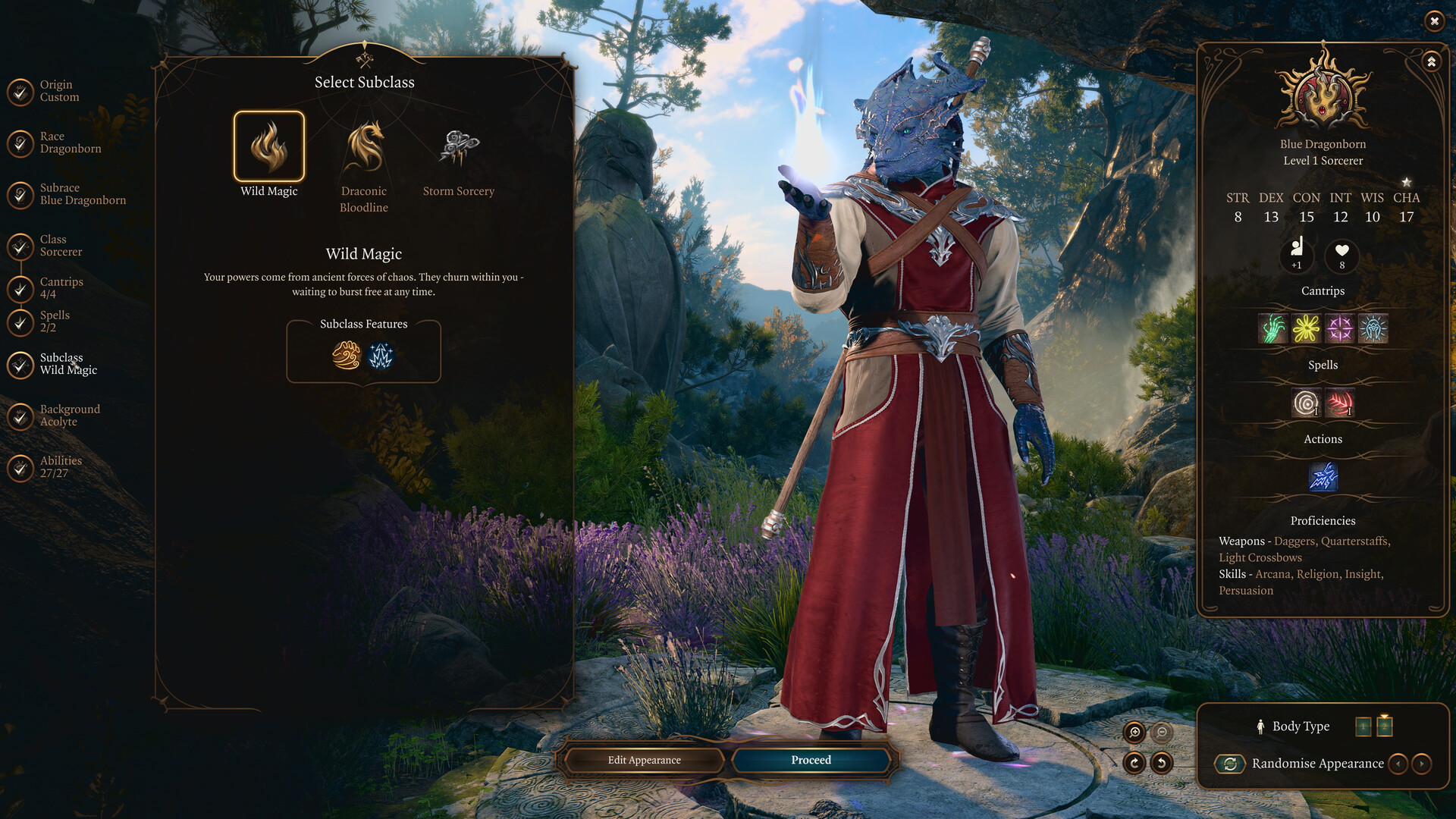
| A | Sorcerer | High spell pressure and metamagic give it explosive turns, especially in focused builds. |
| A | Rogue | Great opener, strong single-target pressure, and excellent exploration value. |
| B | Ranger | Solid sustained value and good early game power, but more situational than the top tiers. |
| B | Warlock | Very dependable between rests, but narrower than the S and A picks. |
| B | Barbarian | Durable and threatening, though less flexible than other frontline choices. |
S Tier Picks
S Tier contains the classes that most consistently elevate a party, whether you are playing solo, in co-op, or on a harder run.
Bard
Bard is S Tier because it combines party utility, strong social coverage, and enough combat options to stay relevant in almost any composition. Its biggest advantage is that it rarely feels wasted: even when it is not carrying damage, it is still smoothing encounters through control, support, and skill checks.
Why it ranks this high:
- Excellent dialogue and skill coverage
- Flexible role as controller, support, or hybrid damage dealer
- Strong payoff in both exploration and combat
- Fits party gaps instead of duplicating them
Bard is especially valuable in a first playthrough because it reduces friction everywhere. If the group needs a face character, a control caster, or a backup support slot, Bard usually has an answer.
Cleric
Cleric is S Tier because it is one of the most dependable classes in the game and has real answers to difficult fights. It brings healing, defensive support, area control, and strong armor options, which makes it much harder to punish than more fragile casters.
Why it ranks this high:
- Strong survivability
- Useful in every phase of the game
- Can shift between support and offense
- Excellent in party play and on punishing difficulty settings
Cleric often becomes even better in difficult fights because damage prevention and battlefield control matter more than raw healing. In a game where action economy is king, making enemies lose turns is often better than trying to patch damage after the fact.
Wizard
Wizard is S Tier because spell versatility is one of the strongest forms of power in Baldur’s Gate 3. It is the class most likely to solve a problem before it becomes a problem, whether that means control, mobility, damage, or utility.
Why it ranks this high:
- Broadest spell toolbox
- Can adapt to many enemy types
- Strong crowd control and combat shaping
- Scales well as you learn encounter patterns
Wizard rewards planning, but it also has the highest ceiling for players who want to control the battlefield. In many runs, it is the class that turns a messy encounter into a clean one.
Paladin
Paladin is S Tier because it brings burst damage, survivability, and strong boss pressure in one package. It is one of the best examples of a class that does not need complicated setup to matter.
Why it ranks this high:
- Very high single-target threat
- Durable enough to stand on the front line
- Punishes important enemies quickly
- Strong sense of impact on every turn
Paladin shines when you want a character who can walk into a fight, absorb attention, and then delete a priority target. It is also a natural fit for players who prefer straightforward power.
A Tier Picks
A Tier classes are excellent, and in many parties they will feel nearly S Tier. They are just a little more conditional, more build-dependent, or slightly less broadly useful.
Fighter
Fighter is A Tier because it is one of the most reliable classes in the game, even if it is not always the flashiest. It brings clean, repeatable damage and a level of consistency that is very hard to dislike.
Why it ranks here:
- Simple, dependable combat performance
- Works well with many weapon setups
- Strong in long encounters
- Easy to plug into almost any party
Fighter is a classic “always useful” pick. It does not need to reinvent the rules; it just keeps delivering value.
Sorcerer
Sorcerer is A Tier because metamagic lets it bend spellcasting in ways that create huge turns. It can feel stronger than Wizard in short bursts, but it usually has less raw flexibility.
Why it ranks here:
- Explosive turn potential
- Metamagic creates unique tactical lines
- High damage and pressure in focused builds
- Great when you know what you want to do
Sorcerer rewards decisive play. If you want to end fights quickly rather than answer every possible scenario, it is a top-level damage caster.
Rogue
Rogue is A Tier because it is excellent at opening fights, picking targets, and handling exploration. Its combat value is more specialized than the S Tier classes, but it remains one of the best tools for single-target pressure.
Why it ranks here:
- Strong first-turn impact
- Great mobility and positioning value
- Excellent skill utility outside combat
- Reliable in stealth-focused play
Rogue tends to rise in value when you care about encounter setup. It may not dominate every battle, but it makes many battles easier before they start.
B Tier Picks
B Tier is still strong. These classes are fully viable, but they usually need more help from party composition, rest pacing, or player preference to match the top picks.
Ranger
Ranger is B Tier because it offers solid sustained damage and practical utility, especially early on. It can feel very good when built around the right weapons or battlefield role, but it is less universally dominant than the higher tiers.
Why it ranks here:
- Good sustained output
- Useful exploration and tracking style value
- Solid early and midgame performance
- Works best with focused builds
Ranger is a stable choice, not a weak one. It simply does not warp the game the way the S Tier classes can.
Warlock
Warlock is B Tier because it is dependable between rests and has a clean identity, but its toolkit is narrower. When its plan works, it works well; when a fight demands broader answers, other casters usually have more options.
Why it ranks here:
- Strong at consistent, repeatable pressure
- Good short-rest efficiency
- Clear combat identity
- Less adaptable than top-tier casters
Warlock often feels better in hands that enjoy a repeatable rhythm. It is not underpowered, just more specific.
Barbarian
Barbarian is B Tier because it is sturdy, threatening, and easy to understand, but its job is narrower than the best frontliners. It wants direct fights and clear targets, which can be a limitation in complex encounters.
Why it ranks here:
- High durability
- Strong melee presence
- Simple and effective in straightforward fights
- Less flexible than Paladin or Fighter
Barbarian is a good pick when you want to hit hard and keep moving. It loses some value when the encounter asks for control, reach, or broader utility.
Matchup and Situational Callouts
The ranking flips in a few common situations, and those context changes matter more in Baldur’s Gate 3 than in many RPGs.
Solo runs can favor self-sufficient classes
In solo play, Bard, Wizard, and Paladin often gain even more value because they can cover multiple problems without relying on teammates. Rogue can also move up if you lean on stealth, scouting, and clean target selection.
Co-op can push support higher
In a four-player group, Cleric and Bard often climb because organized parties benefit from dedicated support and skill coverage. If your team already has plenty of damage, a class that makes everyone else better becomes more valuable than a second burst dealer.
Honor mode increases the price of mistakes
On harder runs, Cleric and Paladin usually feel better because durability and recovery matter more. Fighter also gains value here because reliable turns are safer than elaborate setups that can fail under pressure.
Long adventuring days favor efficiency
If your party pushes through many encounters before resting, Warlock’s short-rest rhythm becomes more attractive. By contrast, classes that rely on a bigger burst window may feel less comfortable when pacing gets tight.
Dialogue-heavy playthroughs change the value of a face character
Bard rises sharply if you want one character to handle conversations, persuasion, and a wide slice of skill checks. In a run where social outcomes matter as much as combat, that kind of coverage is not a luxury.
Patch Delta Note
The exact previous patch movement is unknown from the supplied information, so I am not inventing a change log. What I can say is that this list is anchored to the current live-state context and should be read as a stability-focused snapshot rather than a claim that any specific class moved up or down after a named balance patch.
In practical terms, the safest way to update a Baldur’s Gate 3 tier list is to watch for:
- Changes to action economy
- Spell or feat tuning
- Companion performance changes
- Difficulty pressure in Honor mode and similar challenge settings
For readers comparing versions, the key question is not just “what was buffed,” but “what still solves the most encounters with the least risk.”
FAQ
What is the best class in Baldur’s Gate 3 for beginners?
Bard, Fighter, and Cleric are the safest beginner-friendly choices because they are forgiving and useful in many situations.
Is there a best solo class?
Yes, self-sufficient classes such as Bard, Wizard, and Paladin tend to perform very well in solo play because they can cover multiple roles.
Which class is best for Honor mode?
Cleric, Paladin, and Fighter are among the safest choices because they reduce risk and stay useful when fights get messy.
Does class choice matter more than party composition?
Party composition matters a lot. A lower-ranked class can outperform a higher-ranked one if your group is balanced around its strengths.
Are companions ranked the same way as classes?
Not exactly. Companions are best judged by how well they fit your party and how much effort they take to build into a strong role.
Is Bard actually that good?
Yes. Bard is one of the most broadly valuable classes because it contributes in combat, exploration, and dialogue at the same time.
You might also like
- Baldur's Gate 3 Best Build: Open Hand Monk and Thief Rogue
- Baldur’s Gate 3 Best Builds Guide
- Baldur’s Gate 3 Fun Builds: A Complete Build Guide
- Baldur's Gate 3 Xbox Beginner Guide
- Baldur’s Gate 3 Bard Build: Best Support, Control, and Damage Setup
Sources
You might also like
- Baldur's Gate 3 Classes Beginner Guide
- Baldur’s Gate 3 Beginner Guide: Dice, Early Progression, and Smart Starts
- Baldur's Gate 3 Build Guide: Build Ideas That Actually Work
- Baldur's Gate 3 Beginner Guide: Baldur’s Gate 3 Codes, Early Progress, and Smart Starts
- Baldur’s Gate 3 Find the Missing Letters Beginner Guide
See also
- Baldur's Gate 3 Necromancer Build Guide
- Baldur's Gate 3 Warlock Build Tier List: Best Pacts, Subclasses, and Party Roles
- Baldurs Gate 3 PS5 Beginner Guide
- Baldur's Gate 3 Build Guide: Paladin-Lock Smite Build
- Baldur's Gate 3 Xbox Series X Beginner Guide
- Baldur's Gate 3 Monk Build
- Baldur's Gate 3 Builds: Best Core Build Guide
- Baldur's Gate 3 Treasure Pack Beginner Guide
- Baldur’s Gate 3 Astarion Beginner Guide
- Baldur's Gate 3 Jaheira Build
- Baldur's Gate 3 Confront the Elder Brain: Beginner Guide
- Baldur's Gate 3 Karlach Build Guide
- Baldur’s Gate 3 Evelyn Beginner Guide
- Baldur's Gate 3 Builds Reddit: Best Build Guide
- Baldur's Gate 3 How to Rescue the Grand Duke Beginner Guide
See also
- Baldur’s Gate 3 Achievements Beginner Guide
- Baldur's Gate 3 Investigate the Suspicious Toys Beginner Guide
- Baldur's Gate 3 Investigate the Sel nite Resistance Beginner Guide
- Baldur's Gate 3 Beginner Guide
- Baldur's Gate 3 How to Cure the Poisoned Gnome: Beginner Guide
- Baldur's Gate 3 Build Guide: Best All-Rounder Party Carry
- Baldur's Gate 3 Gloves of Soul Catching Beginner Guide
- Baldur's Gate 3 Kill Raphael's Old Enemy Beginner Guide
- Baldur's Gate 3 Walkthrough
- Baldur’s Gate 3 How to Steal the Sacred Idol: Beginner Guide
- Baldur's Gate 3 Character Creation Beginner Guide
- Baldur's Gate 3 Find the Missing Shipment Beginner Guide
- Baldur's Gate 3 Save the Grymforge Gnomes Beginner Guide
- Baldur's Gate 3 Defeat the Duergar Intruders Beginner Guide
- Baldur's Gate 3 Steal a Githyanki Egg Beginner Guide
Screenshots

Reviewed by
BG3 Hub Editorial
Expertise: Editorial team behind BG3 Hub. Content is compiled from official patch notes, community wikis, and playthrough notes, then reviewed and updated on schedule.
Sources
Baldur's Gate 3 Classes Guides →
Browse the complete classes collection and its focused guides.
Related Guides

🔥 Popular Guides
Baldur's Gate 3 achievements Guide
Complete BG3 achievements guide with rarest unlocks, missables, hidden trophies, and the best route to 100%.

Baldur's Gate 3 xbox mods disable achievements: Achievements Guide
Do BG3 mods disable achievements on Xbox? See rarest, missable, and hidden achievements plus a clean 100% route.
baldur's gate 3 achievements with mods steam deck
How to keep BG3 achievements working with mods on Steam Deck, plus rarest, missable, hidden achievements, and a full 100% route.
Baldur's Gate 3 How to Get to Moonrise Towers
Fast route to Moonrise Towers in BG3, including shadow curse protection, route steps, pitfalls, and verification.
📋 Patch Notes & Updates
🛠️ Popular Tools
Frequently Asked Questions
Quick answers from the guide · click a question to expand.
What is the best class in Baldur’s Gate 3 for beginners?
Bard, Fighter, and Cleric are the safest beginner-friendly choices because they are forgiving and useful in many situations.
Is there a best solo class?
Yes, self-sufficient classes such as Bard, Wizard, and Paladin tend to perform very well in solo play because they can cover multiple roles.
Which class is best for Honor mode?
Cleric, Paladin, and Fighter are among the safest choices because they reduce risk and stay useful when fights get messy.
Does class choice matter more than party composition?
Party composition matters a lot. A lower-ranked class can outperform a higher-ranked one if your group is balanced around its strengths.
Are companions ranked the same way as classes?
Not exactly. Companions are best judged by how well they fit your party and how much effort they take to build into a strong role.
Is Bard actually that good?
Yes. Bard is one of the most broadly valuable classes because it contributes in combat, exploration, and dialogue at the same time.
Was this guide helpful?
Rate this guide so we can improve it.
Share your own tip
Found something not in the guide? Submit it below — our editors review every tip before publishing. No account required.